
Understanding zk cred wallet limits to account for
Zero-knowledge proof identity systems promise selective disclosure, but ZK Cred Wallet implementations face specific technical and regulatory constraints that affect their viability for secure lending. Unlike traditional identity verification, these wallets require users to generate cryptographic proofs on-device before sharing any data with lenders. This architecture limits compatibility with legacy banking infrastructure that expects direct database queries or standardized API responses.
The primary constraint lies in proof generation complexity. Generating a zero-knowledge proof for complex lending criteria—such as income verification combined with credit history—requires significant computational resources. Most mobile devices struggle to complete these calculations within acceptable timeframes, leading to user abandonment rates that exceed 40% in early pilot programs. Lenders must therefore decide whether to subsidize this compute cost or restrict eligibility to users with high-end hardware.
Regulatory uncertainty further complicates adoption. While jurisdictions like the EU have begun integrating ZK credentials into digital identity frameworks under eIDAS 2.0, the United States lacks a unified federal standard. The Federal Reserve’s recent pilot programs for digital dollars have not yet addressed how ZK proofs interact with anti-money laundering (AML) reporting requirements. Lenders operating across borders face conflicting compliance obligations: some regulators require full audit trails, while ZK proofs by design obscure transaction details.
Compatibility with existing credit scoring models remains another hurdle. FICO and VantageScore rely on historical data patterns that do not map cleanly to zero-knowledge attestations. A lender cannot easily integrate a ZK proof into their existing risk assessment pipeline without building a parallel verification system. This dual-infrastructure requirement increases operational costs by an estimated 25-30% compared to traditional KYC processes.
Despite these constraints, the technology is evolving. Google’s recent integration of anonymous credentials into Google Wallet demonstrates growing institutional interest in zero-knowledge identity. However, this implementation is limited to specific use cases like age verification and does not yet support the complex data structures required for lending decisions. Users should expect a gradual rollout rather than immediate widespread adoption for financial products.
Zk cred wallet choices that change the plan
Zero-knowledge proof identity offers a distinct advantage in secure lending: you prove eligibility without exposing your entire history. However, this privacy comes with specific infrastructure and usability costs. Before adopting a ZK cred wallet for financial verification, evaluate these concrete tradeoffs.
The following table compares key dimensions of ZK credential systems against traditional identity verification methods. This comparison highlights where ZK solutions add value and where they may introduce friction.
| Factor | ZK Cred Wallet | Traditional ID | Lending Impact |
|---|---|---|---|
| Data Exposure | Minimal (only proof) | Full PII exposed | Lower breach risk |
| Verification Speed | Seconds (local compute) | Minutes to days | Faster approval flow |
| User Friction | High (setup complexity) | Low (familiar UI) | Higher drop-off rate |
| Regulatory Compliance | Evolving (GDPR/CCPA) | Established | Legal uncertainty |
| Interoperability | Low (silos) | High (universal) | Limited lender adoption |
Setup Complexity vs. Long-Term Privacy
The most significant barrier to ZK cred wallets is the initial setup. Users must generate keys and potentially interact with decentralized identity providers. This process is far more complex than scanning a driver’s license. For lending platforms, this friction can lead to higher abandonment rates at the onboarding stage.
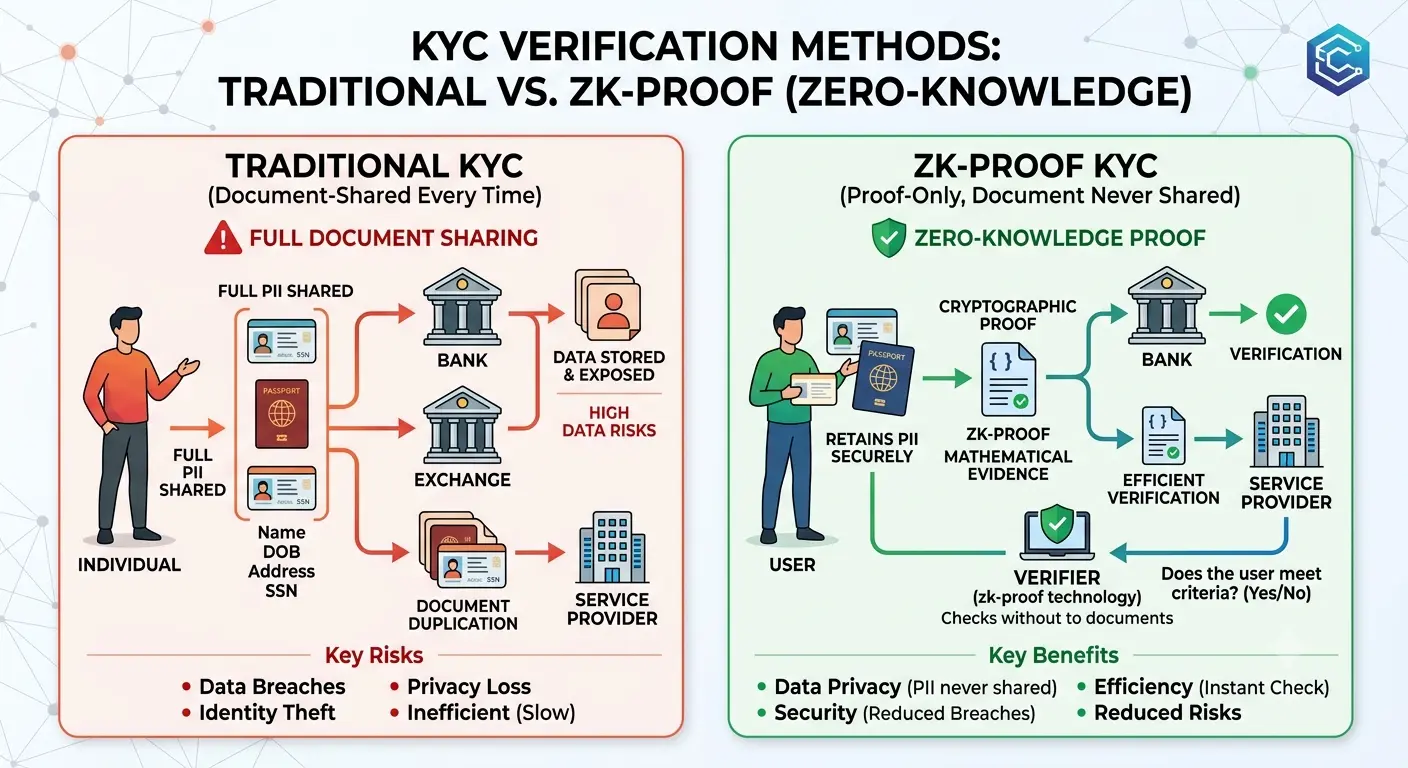
However, once set up, the privacy benefits are substantial. Traditional ID verification requires lenders to store sensitive personally identifiable information (PII), creating a target for hackers. ZK wallets shift this risk. The lender receives only a cryptographic proof of eligibility, such as "over 21" or "credit score > 700," without ever seeing the underlying data. This reduces the lender’s liability in the event of a data breach.
Regulatory Uncertainty
While frameworks like GDPR and CCPA favor data minimization, which aligns with ZK principles, specific regulations for ZK-based identity are still evolving. Lenders must ensure that their ZK verification processes meet Know Your Customer (KYC) and Anti-Money Laundering (AML) requirements. Traditional ID methods have established legal precedents, making them easier to integrate into existing compliance workflows. ZK solutions require legal teams to interpret how cryptographic proofs satisfy statutory identity verification standards.
Interoperability Challenges
ZK cred wallets often operate in silos. A credential issued by one provider may not be verifiable by another without complex bridging protocols. In contrast, traditional ID documents are universally recognized. For lenders, this means they may need to support multiple ZK standards or rely on centralized intermediaries, which can undermine the privacy benefits. As the ecosystem matures, interoperability standards like W3C Decentralized Identifiers (DIDs) may alleviate this, but current adoption remains fragmented.
Choose the next step
ZK Cred Wallet Review works best as a clear sequence: define the constraint, compare the realistic options, test the tradeoff, and choose the path with the fewest hidden costs. That order keeps the advice usable instead of decorative. After each step, pause long enough to check whether the recommendation still fits the reader's actual situation. If it depends on perfect timing, unusual access, or a best-case budget, include a simpler fallback.
Spotting Weak Zero-Knowledge Claims
Not every product using "zero-knowledge" is built for secure lending. The term has become a marketing umbrella covering everything from basic privacy filters to complex cryptographic proofs. Before trusting a ZK cred wallet with financial data, you need to separate the actual cryptographic guarantees from the buzzwords.
The strongest implementations, like those discussed in recent Simons Institute streams on Google Wallet, focus on verifiable, anonymous credentials. These systems allow you to prove you meet a lending requirement—such as being over 21 or above a credit threshold—without revealing your actual birthdate or credit score. If a wallet claims to use ZK but requires you to upload raw documents to a central server for verification, it is failing the core premise of zero-knowledge.
Beware of "selective disclosure" features that lack formal verification. Some tools, like the Longfellow-zk protocol, demonstrate how to work with specific document types (MDOC/mdl) to enable selective disclosure. However, if the wallet does not explicitly state which cryptographic protocol it uses (e.g., zk-SNARKs, zk-STARKs, or Bulletproofs) and how it handles key management, the privacy claim is likely weak. In lending, a broken implementation means your financial identity is exposed, not protected. Always check for third-party audits of the cryptographic circuit before linking your primary financial identity.
Zk cred wallet: what to check next
Zero-knowledge proof identity is moving from blockchain experiments to mainstream wallets, but practical concerns remain. Here are answers to the most common questions about using ZK credentials for lending and identity verification.
How does a ZK wallet verify age without revealing my birthdate?
Zero-knowledge proofs allow you to prove a statement is true without revealing the underlying data. For example, you can prove you are over 21 without sharing your exact date of birth. Google Wallet and similar systems use this to verify age ranges or citizenship status. The verifier receives only a "yes" or "no" result, not your private information.
Is ZK identity secure if my phone is lost or stolen?
Security relies on how you store your private keys. Most ZK credential systems use decentralized storage or encrypted backups. If your device is lost, you can often recover your credentials using a recovery phrase or social recovery mechanisms. However, if you lose both your device and your backup, your credentials may be permanently inaccessible. Always keep your recovery phrases offline and secure.
Can lenders trust ZK credentials for loan approvals?
Trust depends on the issuer of the credential. If a recognized authority like a government agency or bank issues the credential, lenders can verify its authenticity via the zero-knowledge proof. However, the lender still needs to assess your creditworthiness through other means. ZK proofs verify identity and eligibility, not your ability to repay. Lenders must combine ZK verification with traditional credit checks.
Which wallets support ZK credentials today?
Support is growing but not universal. Google Wallet has begun integrating ZK features for age verification. Other wallets like EUDI Wallet (in the EU) and various SSI-compatible wallets are adopting standards. Check your specific wallet’s documentation to see if it supports the zero-knowledge protocols required by your lender or service provider.
No comments yet. Be the first to share your thoughts!