Zero-Knowledge Bridges for Verifiable Credentials Across L2 Rollups

In the bustling ecosystem of Layer 2 rollups, where scalability meets the unyielding demand for privacy, zero-knowledge bridges emerge as the unsung heroes enabling seamless verifiable credentials L2 interoperability. Imagine proving your identity attributes across zkSync, Starknet, or any ZK rollup without exposing a shred of personal data; that’s the promise of ZK credentials bridges. At ZKCredWallet. com, we’re at the forefront, harnessing these technologies to redefine trustless interactions in Web3.

Zero-knowledge rollups have already transformed blockchain scaling by bundling transactions off-chain and validating them with cryptographic proofs that reveal nothing beyond validity. But as these L2s proliferate, siloed credentials hinder true decentralization. Enter ZK bridges: protocols that extend this privacy magic across chains, verifying state transitions and credentials without trusted intermediaries. This isn’t just technical wizardry; it’s a fundamental shift toward a Web3 cross-rollup privacy paradigm where your zero knowledge rollup identity travels freely and securely.
Unlocking the Mechanics of ZK Bridges
At their core, ZK bridges leverage succinct non-interactive arguments of knowledge (SNARKs) or STARKs to attest to events on one chain verifiable on another. Take zkBridge from Berkeley RDI: it verifies block headers permissionlessly, supporting message passing for credentials without external trust. Polyhedra Network’s zkBridge takes it further, slashing on-chain costs for asset and data bridging across L1s and L2s. These aren’t band-aid solutions; they architecturally align with the ZK ethos, ensuring every cross-rollup hop preserves confidentiality.
Consider the workflow. A user holds a verifiable credential in their zkSync zkSync Starknet wallet equivalent on ZKCredWallet. To verify an attribute on Starknet, the bridge generates a ZK proof attesting to the credential’s validity on the source chain. This proof posts to the target rollup, enabling instant, private verification. No multisig committees, no oracles; pure math enforces honesty. Optimistically, as hardware accelerates proof generation, these bridges will handle millions of credential verifications daily, fueling DeFi, DAOs, and beyond.
Key ZK Bridges for L2 Rollups
| Project | Key Feature | Supported Chains | Privacy Level |
|---|---|---|---|
| zkBridge (Berkeley) | Block header proofs | Multi-chain | Full ZK |
| Hyperbridge | Validatorless transfers | Polkadot | Cryptographic |
| zkBridge (Polyhedra) | Low-cost messaging | L1/L2s | SNARK-secured |
| ZK Coprocessor | Private Solana-Aztec exec | Solana/Aztec | STARK-enhanced |
Pioneering Projects Paving the Way
Hyperbridge, launched by Polytope Labs on Polkadot in 2024, ditches traditional validators for pure proofs, making it a beacon for ZK credentials bridge adoption. Its cryptographic backbone ensures assets and credentials flow decentralized and secure. Meanwhile, the ZK Coprocessor Bridge innovates with Wormhole VAAs, letting Solana programs trigger private executions on Aztec L2. These developments signal a maturing landscape where verifiable credentials aren’t chained to one rollup.
Fundamentals here are rock-solid. StarkWare’s ZK proofs for scaling already prove batch efficiency; extending them to bridges multiplies throughput while upholding decentralization. From a tokenomics lens, projects integrating these bridges see boosted utility, as interoperability unlocks network effects. ZKCredWallet users stand to benefit immensely, storing credentials once and verifying anywhere, all while maintaining sovereignty.
Privacy-Preserving Credentials in Action
Verifiable credentials shine brightest through ZK bridges. Traditional VCs risk data leaks during verification; ZK variants let you prove ‘over 18’ or ‘KYC-compliant’ sans details. Across L2 rollups, this means a DeFi protocol on Optimism can trust a Polygon credential via bridge proofs, no revelation required. ScienceDirect’s work on STARKs with anonymous credentials foreshadows this: enhanced privacy across ecosystems.
Challenges persist, like proof recursion for multi-hop bridges, but optimism abounds. Berkeley’s modular zkBridge design future-proofs against them, while Polyhedra optimizes costs. For developers building on ZKCredWallet, this interoperability heralds composability: chain credentials into complex proofs for sybil-resistant governance or selective disclosures in hiring DAOs. The result? A Web3 where privacy scales with ambition.
Developers today can prototype these flows using ZKCredWallet’s SDK, issuing credentials on one rollup and verifying them on another with minimal friction. Picture a DAO on Arbitrum pulling KYC proofs from Base via Polyhedra’s zkBridge; governance strengthens without doxxing members. Or DeFi lenders on Starknet accepting zkSync-bridged credit scores, all zero-knowledge. This verifiable credentials L2 synergy isn’t hypothetical; it’s deployable now, amplifying fundamentals in a crowded L2 arena.
Real-World Use Cases Transforming Web3
Take sybil resistance: ZK bridges let rollups share unique human proofs without merging identities. A Starknet dApp verifies a user’s ‘humanity’ credential from zkSync, thwarting bots at scale. In hiring, Web3 protocols request ‘skills attested’ proofs across chains, bypassing centralized LinkedIn equivalents. Hyperbridge’s Polkadot roots extend this to parachains, where credentials flow for cross-ecosystem DAOs. Even gaming guilds benefit, porting achievement badges privately between rollups. Each case underscores how ZK bridges elevate zero knowledge rollup identity from niche to necessity.
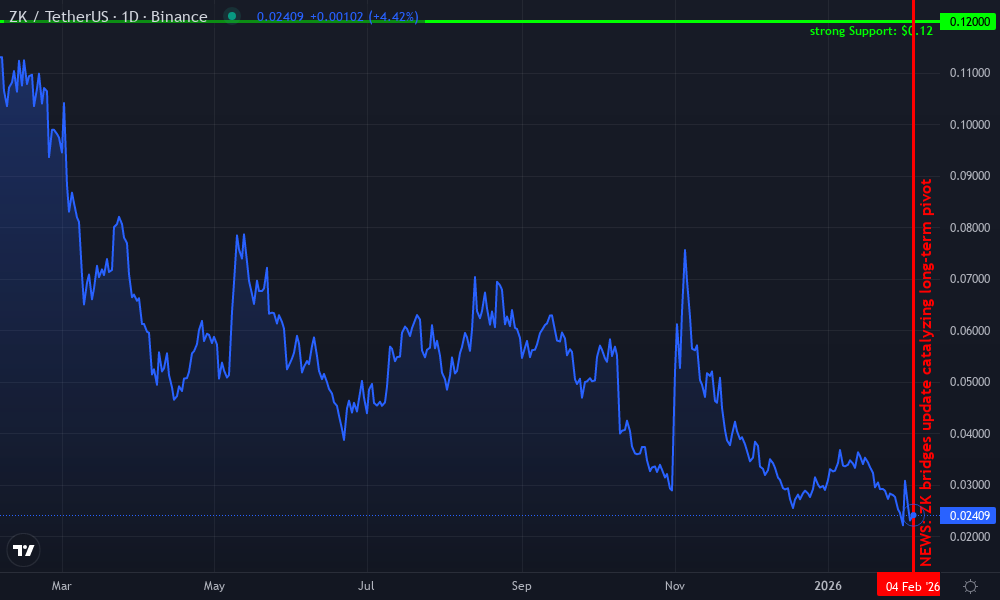
zkSync Technical Analysis Chart
Analysis by Sophia Clark | Symbol: BINANCE:ZKUSDT | Interval: 1D | Drawings: 7
Technical Analysis Summary
On this ZKUSDT 2026 chart, draw a prominent downtrend line from the July peak at 2026-07-20T00:00:00Z (0.75) connecting to the late November low at 2026-11-25T00:00:00Z (0.12), using ‘trend_line’ in red with moderate thickness. Mark key support at 0.12 with a thick green ‘horizontal_line’ labeled ‘Strong Fundamental Support – ZK Bridge Adoption Floor’. Resistance at 0.25 via dashed orange ‘horizontal_line’ as ‘Near-term Distribution Ceiling’. Use ‘rectangle’ for the late October consolidation zone from 2026-10-15 (0.18 high) to 2026-12-01 (0.12 low). Add ‘arrow_mark_up’ at potential entry near 0.13 labeled ‘Fundamentals-Driven Reversal’. Place ‘callout’ texts for volume spike on breakdown: ‘High Volume Distribution Sep-Oct’. Fib retracement from July high to Nov low, focusing 38.2% at ~0.30. Vertical line at 2026-09-15 for ‘Breakdown Event’. Keep drawings clean, balanced, emphasizing fundamental resilience below technical bearishness.
Risk Assessment: medium
Analysis: Technical downtrend intact short-term but ZK fundamentals (bridges, rollups) provide asymmetric upside; my medium tolerance fits pullback buys
Sophia Clark’s Recommendation: Accumulate on dips to 0.12-0.13 for portfolio allocation, hold through volatility—fundamentals underpin rallies.
Key Support & Resistance Levels
📈 Support Levels:
-
$0.12 – Strong multi-touch low with volume dry-up, aligned to ZK bridge cost floor
strong -
$0.15 – Intermediate support from November retest
moderate
📉 Resistance Levels:
-
$0.25 – Overhead resistance from prior consolidation high
moderate -
$0.3 – 38.2% Fib retracement, distribution lid
weak
Trading Zones (medium risk tolerance)
🎯 Entry Zones:
-
$0.13 – Bounce from strong support with positive ZK news divergence
medium risk -
$0.145 – Break above minor uptrend for confirmation
low risk
🚪 Exit Zones:
-
$0.28 – Profit target at resistance confluence
💰 profit target -
$0.11 – Tight stop below key support
🛡️ stop loss
Technical Indicators Analysis
📊 Volume Analysis:
Pattern: high volume breakdown followed by contraction
Sep-Oct spike confirms distribution, current low volume signals accumulation potential amid ZK fundamental strength
📈 MACD Analysis:
Signal: bearish divergence easing
MACD histogram contracting below zero, hinting at momentum shift as fundamentals catch up
Applied TradingView Drawing Utilities
This chart analysis utilizes the following professional drawing tools:
Disclaimer: This technical analysis by Sophia Clark is for educational purposes only and should not be considered as financial advice.
Trading involves risk, and you should always do your own research before making investment decisions.
Past performance does not guarantee future results. The analysis reflects the author’s personal methodology and risk tolerance (medium).
From an analyst’s vantage, these bridges fix a glaring tokenomics gap. Siloed L2s fragment liquidity and utility; bridges consolidate it, driving token demand. zkBridge’s efficiency trims gas fees by orders of magnitude, making credential ops viable for micro-interactions. Polytope’s validatorless model dodges centralization risks plaguing optimistic bridges, aligning with Ethereum’s ethos. ZK Coprocessor’s Solana-Aztec link hints at multi-VM futures, where credentials roam Rust to Cairo seamlessly.
Overcoming Hurdles with Optimistic Innovation
Proof sizes and recursion remain thorny, yet progress accelerates. STARKs offer transparency edges over SNARKs, as ScienceDirect notes in anonymous auth contexts. Berkeley RDI’s modularity swaps proof systems effortlessly, adapting to quantum threats or faster hardware. Costs? Polyhedra’s optimizations already cut verification 90%, with recursion batches on horizon. Regulators eyeing privacy tools will find ZK bridges compliant gold: prove attributes without PII dumps, ticking GDPR boxes effortlessly.
For ZKCredWallet users, this means a unified dashboard for zkSync Starknet wallet management across bridges. Store once, prove everywhere. Developers integrate via our APIs, composing credentials into ZK circuits for novel apps like private airdrop eligibility or cross-rollup rep scores. Fundamentals shine: as L2 TVL swells, bridge-secured credentials capture value, rewarding early adopters.
Enthusiasts tracking Chainalysis or StarkWare insights see the trajectory. ZK-rollups bundle for scale; bridges extend that to interoperability. Alchemy’s bundling proofs pair perfectly with zkBridge headers, birthing ecosystems where privacy compounds. Wilson Center’s verification primer nails it: don’t trust, verify with math.
The horizon glows with potential. As ZK hardware matures, bridges handle real-time credential streams, powering metaverses and socialFi sans surveillance. ZKCredWallet positions you at this nexus, blending storage, proofs, and cross-chain magic. In Web3’s marathon, these bridges don’t just connect rollups; they forge a private, interoperable foundation where credentials empower without exposure. Fundamentals like these fuel enduring rallies, beckoning privacy pioneers forward.